
What Actually Changes When You Add Motion to Sim Racing
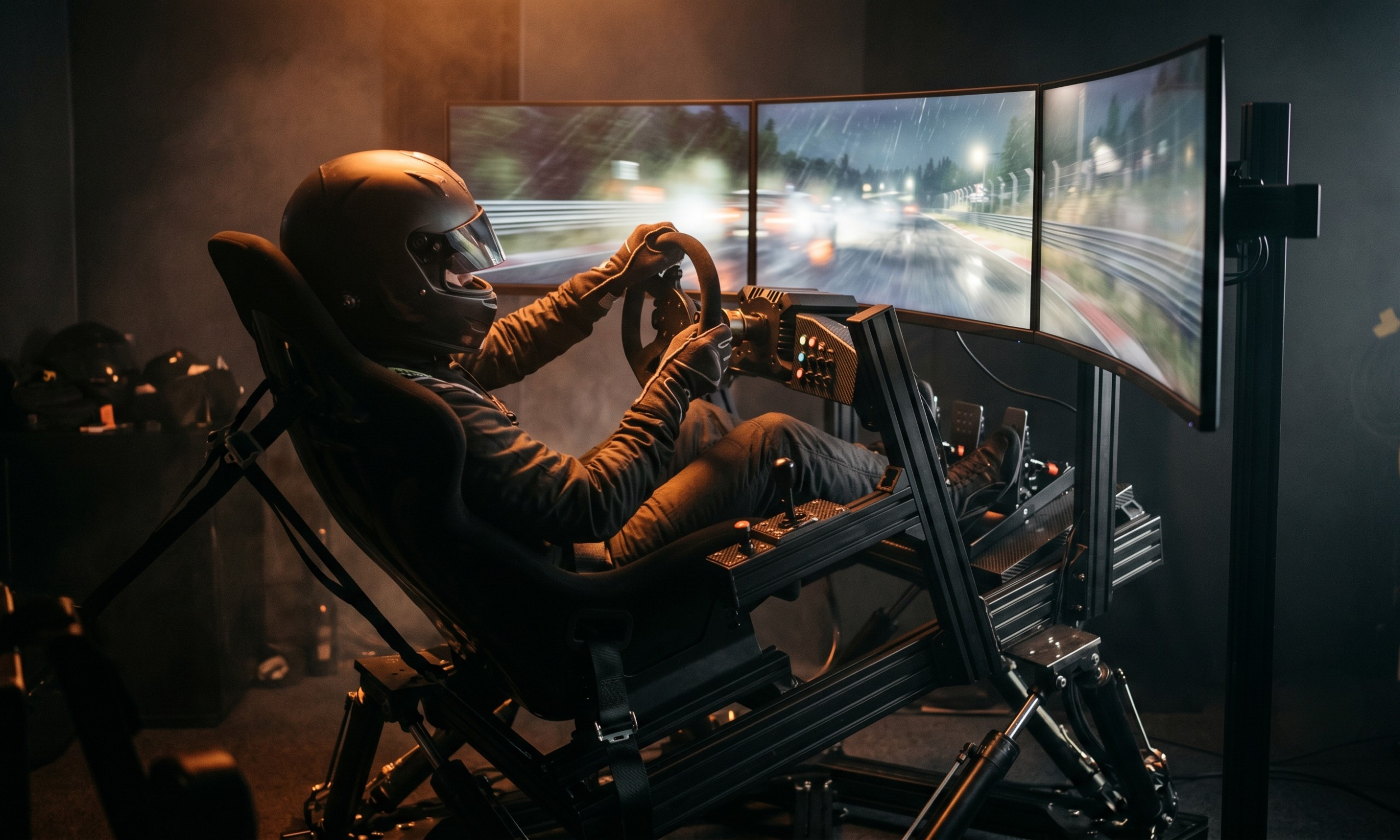
There is a version of this article that tells you motion platforms are life-changing and you need one immediately. This is not that article.
What follows is the honest breakdown of what actually changes when you bolt a motion platform underneath a sim racing rig. What gets better, what does not change at all, and what you need to know before deciding whether the money is worth it.
The first thing you notice is not what you expect
Most people assume the biggest change will be the drama. The hard braking, the crash impact, the aggressive kerb strikes. Those moments are impressive, but they are not where motion earns its keep.
The first thing that genuinely changes is the mid-corner information. When the rear of the car starts to slide, you feel it through your body before you see it on screen. When the car understeers wide, you feel the front push through the platform's refusal to roll further. These are small, subtle cues that arrive a fraction of a second before the visual feedback, and they change how you drive.
It is the same information a real driver gets through the seat of their trousers, the chassis, the steering column. Without motion, you are driving entirely on visual and audio cues. With motion, your body joins the conversation.
The immersion shift is real, but it is quieter than you expect
Nobody straps into a motion rig and screams. What happens is more interesting than that. After about twenty minutes, you stop noticing the motion. It just becomes the way the car feels. You stop thinking about the platform and start thinking about the car. The rig disappears and the experience takes over.
That is immersion in its truest form. Not spectacle, but transparency. The platform stops being a piece of hardware and becomes part of the sensation of driving.
This is also where motion and VR together become genuinely special. The visual world moves, and your body moves with it. The sensory conflict that causes VR sickness in sim racing shrinks dramatically because the physical cues now match what your eyes are telling your brain. For a lot of people, motion is what makes long VR sessions actually comfortable.
Does motion make you faster?
Honest answer: it depends on what you were doing wrong before.
If you were over-driving because you could not feel the car's limits, motion will slow you down initially and then make you consistently faster. You start driving within the car's grip envelope because you can physically feel where the edge is, the way a real driver does.
If you were already fast on a static rig using visual cues and audio, motion may not add raw lap time. What it will add is consistency. Over a long stint, the physical feedback reduces the mental effort of driving, which means fewer mistakes in the closing laps of a race when fatigue sets in.
Professional racing teams use motion simulators not because they make a driver three seconds faster on a single lap, but because they make a driver half a second more consistent across an entire race distance. That is where real performance lives.
What motion does not fix
Motion does not fix a bad rig. If your cockpit flexes, your pedals move, or your wheel mount wobbles, adding a motion platform underneath amplifies every weakness in the structure. The platform moves the whole rig, so anything loose or sloppy gets worse, not better.
Motion does not replace good force feedback. The steering feel still comes from the wheelbase, not the platform. A strong direct-drive wheel on a static rig will always feel better than a weak wheel on a motion platform.
Motion does not make a slow internet connection faster, fix your braking technique, or stop you getting punted at turn one in public lobbies. It adds physical feedback, nothing more, nothing less.
The honest cost calculation
A capable motion platform for sim racing starts at around £800 for a seat mover and £2,000 to £3,000 for a full 2DOF or 3DOF platform. That is real money, and it is worth asking what it buys you compared to spending the same on other upgrades.
If you are still on a belt-drive wheel and basic pedals, spend the money there first. A direct-drive wheelbase and load-cell pedals improve the racing experience more, per pound spent, than a motion platform added underneath a weak foundation.
If you already have a solid cockpit, a decent direct-drive wheel, and good pedals, motion is the upgrade that changes the experience most dramatically. Nothing else you can buy at that point transforms the sensation of driving as much as a good platform does.
The bottom line
Motion does not make sim racing a different hobby. It makes it a deeper version of the same hobby. The car feels like a car in a way it did not before. Corners have weight. Kerbs have texture. Traction loss has consequence. You drive with your body, not just your eyes and hands.
Whether that is worth the money is a personal calculation. But what it changes is not hype or marketing. It is physics, applied to the seat of your trousers.
FullMotionSim is an independent publication. We are not paid by manufacturers to write about their products.
