
2DOF vs 3DOF vs 4DOF vs 6DOF: How Many Axes of Motion Do You Actually Need?
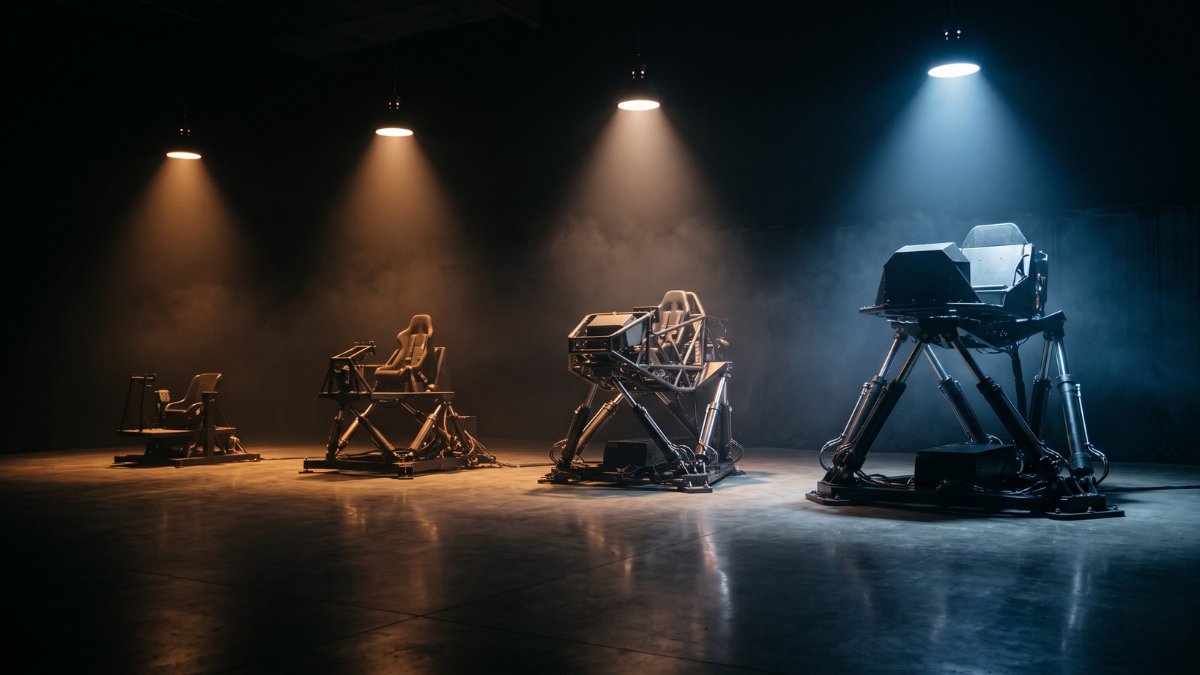
It is the first question everyone asks and the one most likely to lead you down a rabbit hole of spec sheets, forum arguments, and YouTube influencers who happen to be sponsored by whoever makes the platform they are recommending. How many degrees of freedom do you actually need?
The honest answer is that it depends on what you are doing, how sensitive you are, and how much space and money you have. But that is a useless answer on its own, so here is the full breakdown: what each configuration actually gives you, what it leaves out, and where the real diminishing returns kick in.
What degrees of freedom actually mean
Before the comparison, the basics. Degrees of freedom (DOF) describe how many independent axes a motion platform can move in. There are six possible axes in total.
Pitch is the nose going up and down. You feel this under braking and acceleration in a car, and during climb and descent in an aircraft.
Roll is the tilt left and right. You feel this in cornering load in a car and in banking turns in an aircraft.
Heave is the straight up and down movement. You feel this going over bumps and crests in a car, and in turbulence and altitude changes in an aircraft.
Surge is the push forward and backward. You feel this as acceleration pressing you into the seat and braking pushing you forward.
Sway is the push left and right. You feel this as lateral g-force in a corner or a crosswind pushing the aircraft sideways.
Yaw is the rotation around the vertical axis. You feel this when the rear of a car steps out in oversteer or when an aircraft yaws in a sideslip.
A 2DOF platform moves in two of these axes. A 6DOF platform moves in all six. The question is which axes matter most for your use, and where the extra axes stop adding enough value to justify the cost.
2DOF: Pitch and Roll
What it gives you: The two cues your body is most sensitive to in simulation. Braking tips the platform forward, acceleration tips it back, and cornering rolls you into the turn. These two axes cover the fundamental "I am in a moving vehicle" sensation.
What it misses: Heave (bumps, crests, turbulence), surge (the push of acceleration against your back), sway (lateral force in corners), and yaw (oversteer rotation). You feel direction and weight transfer but not vertical movement or lateral force.
Who it suits: First-time motion buyers who want to experience what motion adds without the full commitment of a larger platform. Sim racers on a budget. Flight sim pilots who want the banking and pitch cues that transform VR comfort. Anyone with limited space, because 2DOF platforms tend to have the smallest footprint.
The honest take: 2DOF is where the single biggest jump in experience happens. Going from static to 2DOF is a dramatically larger change than going from 2DOF to 3DOF or from 3DOF to 6DOF. If you have never experienced motion, a 2DOF platform will change how you feel about simulation. It will not give you everything, but it gives you the two things that matter most. Many people who start here end up satisfied enough to stay.
Typical price range (UK, 2026): £1,500 to £3,000 for a capable platform.
3DOF: Pitch, Roll, and a Third Axis
What it gives you: The two foundation cues plus one more. Which third axis you get depends on the platform. Some add heave (up and down), some add traction loss or yaw (rear-end rotation). The choice of third axis changes the character of the motion significantly.
Heave as the third axis adds the vertical movement that makes bumps, crests, and turbulence feel physical. For flight sim, heave is the axis that gives you the stomach-drop in turbulence and the settle on landing. For racing, it adds the sensation of going over kerbs and crests. The eMotion e3 is a good example of a 3DOF with true heave, and the feel is noticeably different from a 3DOF that adds traction loss instead.
Traction loss as the third axis adds the rear-end movement that tells you when the car is sliding. For sim racing, this is arguably more useful than heave because oversteer and traction loss are critical driving cues that you respond to instinctively. The DOF Reality H3 is the most popular example of this configuration.
What it misses: Depending on which third axis is present, you are still missing three to four of the six possible axes. A 3DOF with traction loss has no heave, surge, or sway. A 3DOF with heave has no traction loss, surge, or sway.
Who it suits: The largest number of motion platform buyers. 3DOF is the sweet spot where cost, capability, and realism converge for most people. If you are buying one platform and you want the best balance of "enough motion to feel convincing" and "not spending five figures", 3DOF is almost certainly where you land.
The honest take: 3DOF is where most people should buy and where most people do buy. The third axis adds meaningful information on top of the pitch and roll foundation, and the total package feels substantially more complete than 2DOF. The law of diminishing returns has not kicked in yet at this level. Every pound spent on the step from 2DOF to 3DOF buys a noticeable improvement.
Typical price range (UK, 2026): £2,500 to £4,500 for a capable platform.
4DOF: Four Axes
What it gives you: The three foundation axes plus one more. Typically this means pitch, roll, heave, and yaw, giving you both the vertical movement and the rotational movement in one platform. The sensation is noticeably more complete than 3DOF. Cornering has roll and yaw together, which feels more realistic than either alone. Bumps and crests have vertical texture. The overall motion envelope covers most of what your body expects to feel.
What it misses: Surge and sway. You do not get the push forward under braking or the lateral force in corners. These are the two hardest axes to simulate convincingly without a very large travel range, which is one reason most 4DOF platforms omit them rather than delivering them poorly.
Who it suits: Experienced sim racers and flight sim pilots who have used 2DOF or 3DOF and want more without jumping to the cost and complexity of 6DOF. Buyers who want heave and yaw together rather than choosing one or the other. DCS and combat flight sim pilots benefit particularly from 4DOF because the aggressive manoeuvring in a fast jet produces meaningful cues across all four axes.
The honest take: 4DOF is where diminishing returns start to become visible. The jump from 3DOF to 4DOF is real but less dramatic than the jump from 2DOF to 3DOF. You are adding refinement and completeness, not transforming the experience. For many people, the cost of that additional axis is better spent on a higher quality 3DOF platform than on a fourth axis from a cheaper manufacturer. Quality of motion matters more than quantity of axes. A fast, precise 3DOF platform can feel more convincing than a slow, mushy 4DOF platform.
Typical price range (UK, 2026): £3,500 to £6,000 for a consumer platform, significantly more for premium.
6DOF: The Full Envelope
What it gives you: Everything. Pitch, roll, heave, surge, sway, and yaw. The platform can reproduce the full range of motion that a real vehicle produces, within the physical constraints of its travel range. A well-configured 6DOF platform in VR is the closest you can get to being inside a moving vehicle without actually being inside a moving vehicle.
What it misses: Sustained forces. No consumer platform can sustain real g-force. A car pulling 3G in a corner pushes you sideways with three times your body weight. A 6DOF platform can give you the onset cue (the initial push) but cannot sustain it. Your brain fills in the rest remarkably well, especially in VR, but it is worth understanding that even 6DOF is simulating the sensation, not replicating the physics.
Who it suits: Serious enthusiasts with the budget and the space. Professional training installations. Commercial venues. Sim racers and flight sim pilots who have lived with lower-DOF platforms and know exactly what they want more of. Anyone who has decided motion simulation is a permanent, central part of their setup rather than an experiment.
The honest take: 6DOF is the ceiling of what home motion simulation can deliver. It is also the point where the law of diminishing returns is in full effect. The step from 3DOF to 6DOF adds three more axes and costs three to ten times as much. Each additional axis adds genuine fidelity, but the total experience is not three to ten times better. It is incrementally more complete. Whether that increment is worth the money depends on your sensitivity, your expectations, and your budget. Nobody who has used a properly configured 6DOF platform would describe it as anything less than spectacular. But plenty of people using a well-tuned 3DOF platform would describe their experience as deeply satisfying without ever feeling like they are missing something critical.
Typical price range (UK, 2026): £5,000 to £25,000+ for consumer platforms. Professional installations go significantly higher.
The question nobody asks but should
How many DOF do you need is the wrong question. The right question is: at my budget, would I get a better experience from more axes or better actuators?
A premium 2DOF platform with industrial linear actuators (responding in 8 milliseconds, smooth, precise, silent) can feel more convincing than a budget 6DOF platform with slow motors and sloppy gearing (responding in 40 milliseconds, jerky, noisy). Your brain is more sensitive to the timing and quality of the motion cue than to the number of axes delivering it.
If your budget is £3,000, a high-quality 3DOF platform from a reputable manufacturer will serve you better than a cheap 6DOF platform from an unknown brand. Quality of motion is the thing that separates a convincing experience from a gimmicky one, and quality lives in the actuators, the control software, and the frame stiffness, not in the number of axes printed on the box.
The practical matrix
For readers who want the straight answer without reading two thousand words:
Budget under £2,000: 2DOF. Get the two cues that matter most and invest in a solid cockpit underneath it.
Budget £2,000 to £4,000: 3DOF. The sweet spot for most buyers. Choose between heave or traction loss as your third axis based on whether you fly or race.
Budget £4,000 to £8,000: 3DOF or 4DOF from a premium manufacturer. At this budget, spend on quality over quantity. A fast, precise 3DOF beats a mediocre 4DOF.
Budget £8,000 to £20,000: 4DOF to 6DOF from an established brand. At this point you can afford both quality and quantity.
Budget £20,000+: 6DOF with industrial actuators. This is the full experience, no compromises.
A note on VR
VR changes the calculation slightly. In VR, your brain is more immersed visually, which makes it more sensitive to physical motion cues (or the absence of them). The minimum viable DOF for comfortable VR is 2DOF (pitch and roll), because these two axes address the primary sensory mismatch that causes VR sickness.
Adding heave (3DOF) improves VR comfort further, especially in flight where altitude changes are constant. Adding yaw (4DOF) helps in aggressive racing and combat flying. The diminishing returns curve for VR tracks the same shape as for flat-screen simulation, but the starting point (the value of those first two axes) is even higher because VR amplifies the benefit of matching physical motion to visual motion.
The bottom line
More axes is not automatically better. Better axes is better. Start with the two that matter most, add more as your budget and experience justify, and never buy a higher DOF count at the expense of build quality or actuator speed. The number on the spec sheet is less important than the feeling underneath you.
Full Motion Sim is an independent publication. We are not paid by manufacturers to write about their products. Product recommendations may include links to retailers from whom Full Motion Sim earns a commission. This does not affect our editorial independence.
