
Motion Plus VR: Why the Combination Is Greater Than Either Alone
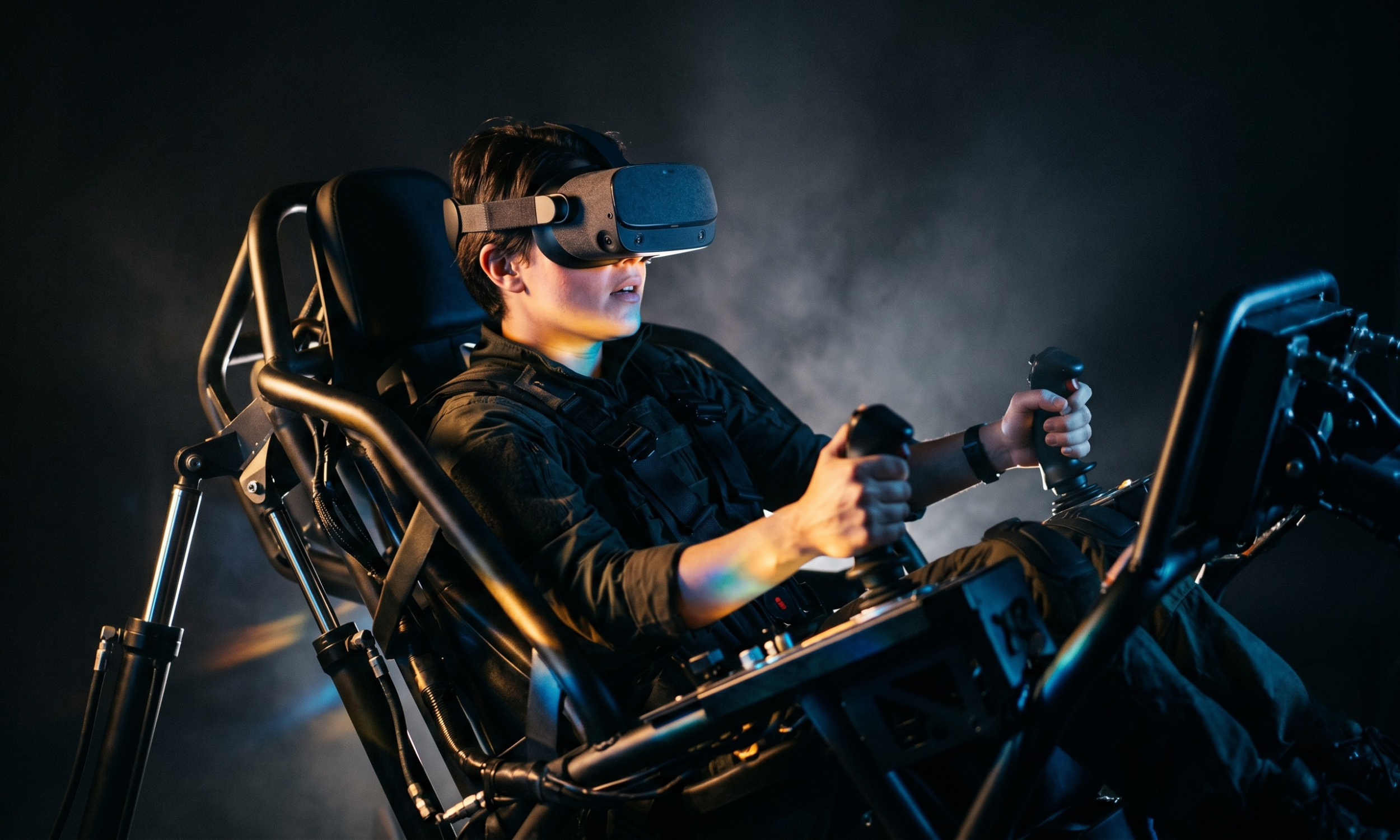
You can use a motion platform without VR. You can use VR without a motion platform. Both are good. But using them together is a fundamentally different experience that neither delivers alone, and understanding why is the key to getting the most from both.
This is not a technical specification comparison. It is about what happens to your brain when visual immersion and physical motion agree with each other, and why that agreement changes simulation from something you watch to something you inhabit.
The problem each technology solves on its own
VR alone removes the frame. You are no longer looking at a screen that sits inside a room. You are inside the environment. The cockpit surrounds you. The track stretches ahead. The sky wraps over. Spatial awareness becomes instinctive rather than interpreted. You judge distances, apexes, and closing speeds the way you do in real life, using depth and scale rather than a flat rectangle.
The limitation of VR alone is that your body knows it is lying. Your eyes see the car corner hard to the left, but your inner ear feels nothing. Your vestibular system, the part of you that senses motion and balance, sits quietly in a stationary chair while your visual system insists you are moving at 180 miles per hour through Eau Rouge. That disagreement is the root cause of VR sickness, and it is also a ceiling on how immersive VR can actually feel. Your conscious mind is in the simulation. Your body is not.
Motion alone adds physical feedback to the experience. The platform tilts, rolls, pitches, and heaves in response to what is happening in the simulation. You feel braking load, cornering force, kerb strikes, turbulence, and traction loss through your body. It adds a layer of information and sensation that a static rig cannot provide.
The limitation of motion alone is that you are still looking at a screen, or screens, that sit in a room. The physical cues are real, but the visual frame is still a rectangle mounted on a desk. You can see the edges. You can see your room. The motion is convincing but the visual context constantly reminds you that you are in a room, not in a cockpit.
What happens when you combine them
When you pair motion with VR, both limitations cancel each other out.
VR removes the visual frame. Motion fills the physical gap. Your eyes see the car corner and your body corners with it. Your eyes see the plane bank and your body banks. The sensory conflict that causes VR sickness shrinks dramatically because the two systems, visual and vestibular, are finally telling your brain the same story.
The result is an immersion depth that neither technology achieves alone. You stop being a person watching a simulation. You start being a person inside a vehicle that happens not to exist.
This is not marketing language. It is neuroscience applied to entertainment and training. When the visual and physical cues align, your brain processes the experience as real at a deeper level than either cue delivers independently. This is the same principle that makes professional flight simulators pair motion bases with visual domes, and it translates directly to home setups.
The VR sickness question, answered properly
The single most common reason people try VR for sim racing or flight sim and abandon it is motion sickness. The irony is that adding physical motion, more movement, often reduces the nausea rather than increasing it.
This feels counterintuitive until you understand the mechanism. VR sickness is not caused by motion. It is caused by the absence of expected motion. Your eyes see movement, your body feels stillness, and your brain interprets the contradiction as a sign that something is wrong. Nausea is the body's defensive response.
A motion platform provides the expected motion. When the car corners, the platform rolls and your body leans with it. The visual rotation and the physical rotation agree. The contradiction shrinks. The nausea response has less reason to fire.
This does not mean motion is a guaranteed cure for every person in every scenario. Three honest caveats matter.
The motion has to match the visuals. If the platform moves in a way that contradicts what the VR headset is showing, the mismatch gets worse. Latency, incorrect axis mapping, or a badly tuned motion profile can increase sickness rather than reducing it. Setup and calibration are not optional.
Not all VR sickness is vestibular. Some nausea comes from low frame rates, display lag, incorrect IPD settings, or a headset that sits wrong on the face. Motion does not fix hardware or software problems. Fix those first.
Individual sensitivity varies. Most people report significant improvement with well-tuned motion. A small percentage remain sensitive regardless. There is no honest way to guarantee a specific outcome for a specific person.
That said, the trend is clear and consistent. Across sim racing, flight simulation, and professional training applications, the addition of matched physical motion reduces reported VR discomfort for the majority of users. It is one of the most reliable solutions available, and it is the reason that professional VR training systems almost always include a motion component.
What "matched motion" actually means in practice
The phrase "matched motion" deserves unpacking because it is where the quality of the experience lives.
A motion platform does not reproduce the actual forces you would experience in a real vehicle. A Formula 1 car pulls 5G in a corner. A motion platform tilts a few degrees. The actual acceleration your body experiences is nowhere near what the real thing delivers.
What the platform does is provide onset cues. The initial direction and timing of the motion matches what your eyes see. When the car turns left, the platform rolls left at the same moment. Your brain reads the direction and timing of the cue and fills in the magnitude. It does not need the full 5G to believe the corner is happening. It needs the right cue at the right time in the right direction.
This is why a well-tuned 2DOF platform with only pitch and roll can feel remarkably convincing in VR. The two axes that matter most, the ones that align with what your vestibular system is most sensitive to, are enough to satisfy your brain's basic requirement for physical confirmation of visual motion.
More axes add more fidelity. Heave adds the stomach-drop of altitude changes. Surge adds the push of acceleration and braking. But the foundation of the experience, the thing that makes VR plus motion feel qualitatively different from VR alone, is the timing and direction match on the primary axes. Get that right and the rest is refinement.
Practical considerations for pairing motion with VR
If you are considering adding motion to a VR setup, or adding VR to a motion rig, a few practical points are worth knowing.
Cable management matters more than you think. A VR headset on a motion platform means a cable (or a wireless transmitter) on a moving rig. Cables can snag, pull, and disconnect if not routed carefully. Wireless VR (or a well-mounted cable management system) makes the experience dramatically smoother.
Frame rate is non-negotiable. VR on a motion platform is more sensitive to frame drops than VR alone, because the motion cue arrives on time but the visual lags behind it. Maintain 90fps or higher. If your PC cannot hold that, reduce visual settings before reducing frame rate.
Start with motion intensity low. When you first pair motion with VR, run the motion at 50 to 60 percent of its range. Let your brain adapt to the combined input over a few sessions. You can always increase intensity once you are comfortable. Starting at maximum is the fastest way to make yourself ill.
Per-application motion profiles are essential. A sim racing motion profile should feel different from a flight sim profile. Most middleware (SimRacing Studio, SimHub, FlyPT Mover) allows per-game and per-vehicle profiles. Take the time to tune each one. The default is never the best.
Where this is heading
The trajectory is clear. VR resolution continues to improve. Motion platform costs continue to fall. Middleware is becoming more sophisticated. Wireless VR is becoming standard. Each of these trends makes the combined experience better, cheaper, and more accessible.
In professional training, motion plus VR is already the expected standard for serious simulation. In the consumer space, it is following the same adoption curve that VR itself followed five years ago, moving from enthusiast curiosity to informed recommendation to expected component of a serious setup.
If you already have one half of the equation, the other half is the single most transformative upgrade you can make. And if you are starting from scratch, building with both in mind from the beginning is the most efficient path to the deepest simulation experience available in 2026.
FullMotionSim is an independent publication covering motion simulation across every use case. We are not affiliated with any manufacturer or training provider.
