
The Quiet Boom in Commercial Motion Simulation
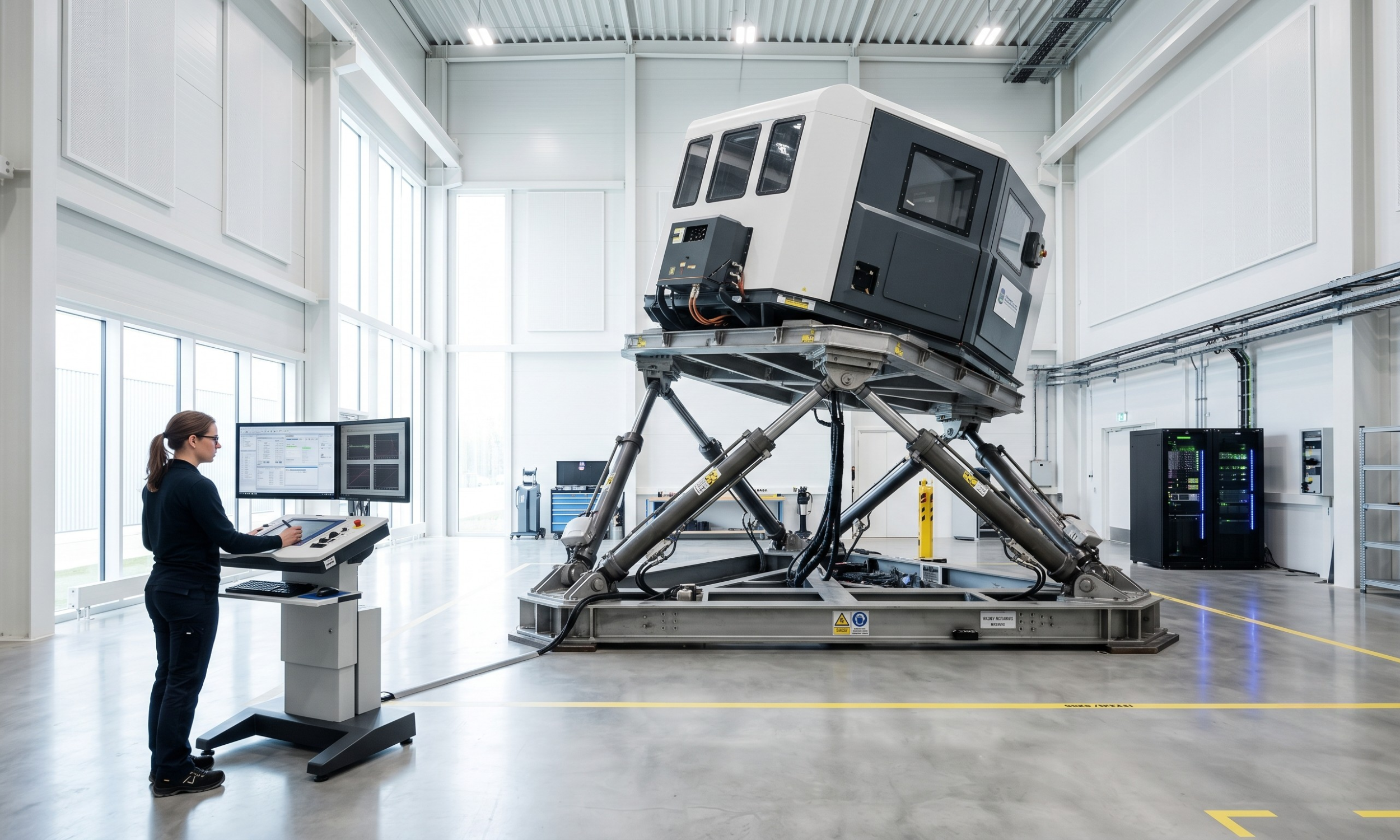
If you only follow the consumer side of motion simulation, you could be forgiven for thinking the market is all about sim racing rigs and flight cockpits in spare bedrooms. It is not. The quieter, larger, and faster-growing side of motion simulation is commercial, and in 2026 it is expanding into industries that most people would not immediately connect to the technology.
Defence and military training get the headlines. But motion platforms are now being specified and procured by automotive manufacturers, healthcare providers, research institutions, theme park operators, rehabilitation clinics, and professional driver training organisations. The common thread is simple. Any task where physical motion affects human performance, decision-making, or safety can benefit from training on a platform that moves.
Here is where the market actually is, where it is heading, and why the commercial side of motion simulation is worth paying attention to even if you have never thought about it before.
Defence and military training
This remains the largest and most established commercial application for motion simulation. Military forces worldwide use motion platforms in flight simulators, ship bridge trainers, vehicle simulators, and increasingly in VR-based training systems for roles that would previously have been trained exclusively in the field.
The shift in 2026 is not that defence organisations are using motion. They have done that for decades. The shift is in what they are willing to procure and from whom. The traditional model of multi-million pound full-mission simulators built by prime defence contractors still exists, but alongside it a market for smaller, more focused, bespoke motion platforms is emerging.
A naval training organisation that needs a deck motion trainer for ship marshalling does not necessarily need a full bridge simulator. A 3DOF platform with VR integration, built to spec by a specialist motion manufacturer, can deliver the training effect at a fraction of the cost. This is opening the defence simulation market to smaller specialist builders who can deliver bespoke solutions faster and more affordably than the established primes.
Automotive and driver training
Professional driver training is one of the clearest commercial applications for motion simulation. Racing teams have used simulators for years, but the technology is now being adopted by advanced driver training organisations, fleet operators, and automotive manufacturers for purposes that go beyond motorsport.
Fleet operators use motion simulators to train drivers in hazardous conditions (ice, aquaplaning, emergency braking, load shift) without the risk and cost of replicating those conditions on a real road. The motion platform provides the physical feedback that makes the training transfer to real-world behaviour, which is the critical gap that screen-based training cannot bridge.
Automotive manufacturers use motion simulators in the vehicle development process. Testing driver ergonomics, ride comfort, and control response on a simulator with realistic motion is faster and cheaper than building and testing physical prototypes for every iteration. As vehicles become more complex (electric drivetrains, autonomous features, active suspension systems), the simulation stage of development is expanding rather than contracting.
Healthcare and rehabilitation
This is the application that most people do not see coming, and it is growing faster than almost any other segment.
Motion platforms are being used in balance rehabilitation for patients recovering from stroke, brain injury, and vestibular disorders. The platform provides controlled, repeatable, progressive motion challenges that help patients retrain their balance and spatial orientation in a safe environment.
The integration with VR is particularly powerful in this context. A patient stands on a gently moving platform while a VR headset presents visual scenarios that challenge their balance responses. The therapist controls the intensity and the scenario, progressing the patient through increasingly complex motion environments as their recovery advances.
Research institutions are also using motion platforms to study human responses to motion, spatial disorientation, motion sickness, and vestibular function. The ability to deliver precise, repeatable motion stimuli in a controlled laboratory setting makes motion platforms a valuable research tool.
Theme parks and location-based entertainment
Theme park rides have used motion simulation for decades, from the early Star Tours at Disney to the sophisticated dark rides and VR experiences in modern parks. What is changing is the scale and accessibility of the technology.
Location-based entertainment venues, smaller than full theme parks but larger than home setups, are using motion platforms to offer paid simulation experiences to the public. VR racing, flight experiences, and immersive entertainment rides powered by motion platforms are appearing in shopping centres, entertainment complexes, and standalone venues.
The commercial model is straightforward. A motion platform that costs a few thousand pounds can generate significant ticket revenue in a high-traffic location. The technology is reliable enough for continuous commercial use, and the VR content can be updated without changing the hardware.
Research and academia
Universities and research laboratories use motion platforms for human factors research, psychology experiments, engineering education, and aerospace studies. The controlled delivery of motion stimuli allows precise experimental conditions that cannot be achieved any other way.
Motion platforms in academic settings range from simple 2DOF teaching aids to sophisticated six-axis systems used for postgraduate research. The cost reduction in motion hardware over the past five years has made platform-based research accessible to departments that previously could not justify the expenditure.
The market forces driving adoption
Several factors are converging to push commercial motion simulation beyond its traditional boundaries.
Cost reduction. Motion platform hardware has become significantly more affordable. A capable 3DOF platform that would have cost tens of thousands five years ago can now be built or procured for under five thousand. This price point opens the technology to organisations that previously could not justify it.
VR maturity. The latest generation of VR headsets delivers resolution, comfort, and reliability that makes them viable for professional and commercial use, not just gaming. The combination of motion plus VR creates a training or experience environment that is dramatically cheaper than physical replicas.
Proven training transfer. The evidence base for simulation-based training, including the specific contribution of motion fidelity, has matured. Procurement teams can now justify motion platform purchases with data on training effectiveness rather than relying on intuition.
Bespoke capability. The emergence of specialist motion platform builders who can design and manufacture platforms to specific commercial requirements, rather than offering only off-the-shelf consumer products, has made motion simulation accessible to organisations with unique training or operational needs.
What this means for the market
The commercial motion simulation market is not replacing the consumer market. It is growing alongside it, using much of the same underlying technology, and creating demand for engineering capability, custom software development, and application-specific expertise that the consumer market does not require.
For manufacturers and integrators, the commercial opportunity is significant. For training organisations and enterprises, the barrier to entry has never been lower. And for the motion simulation industry as a whole, the expansion beyond gaming and entertainment into serious professional applications is the clearest signal that the technology has matured from novelty to necessity.
FullMotionSim is an independent publication covering motion simulation across every use case. We are not affiliated with any manufacturer or training provider.
