
How Motion Platforms Are Changing Naval and Maritime Training
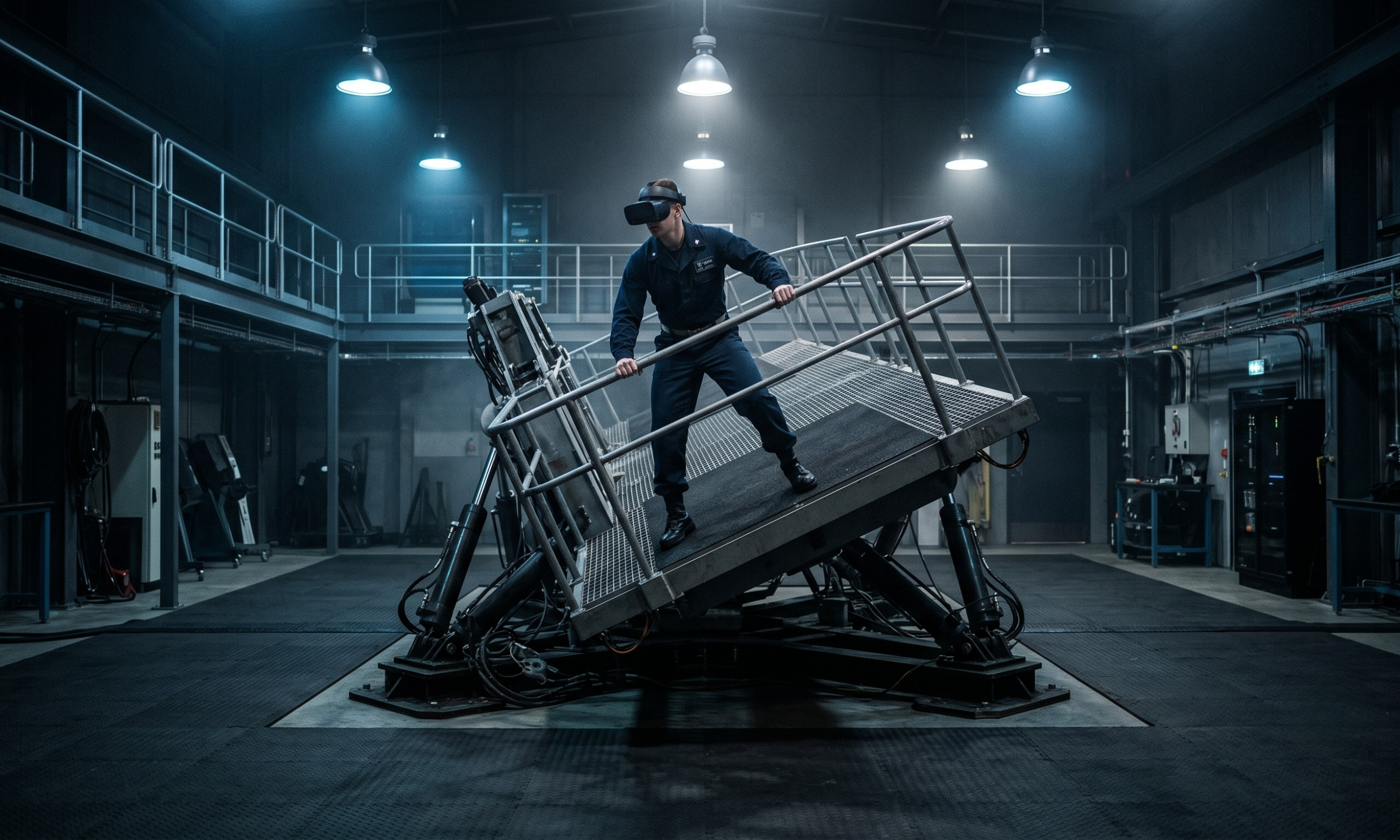
When people hear "motion simulator," they think of a racing rig in a spare bedroom or a flight cockpit in a garage. They rarely think of the sea. But maritime and naval simulation is one of the oldest and most serious applications of motion technology, and in 2026, the sector is going through a period of change that is worth paying attention to.
The platforms are getting smaller. The costs are coming down. The fidelity is going up. And the line between a million-pound full-mission bridge simulator and a bespoke motion platform built for a specific training task is starting to blur in ways that create real opportunities for smaller organisations, training providers, and defence contractors who previously could not afford to play in this space.
Why motion matters more at sea than almost anywhere else
The ocean moves. Constantly, unpredictably, and in every axis simultaneously. A ship in moderate seas experiences pitch, roll, heave, surge, sway and yaw all at once, and the crew working on deck or on the bridge has to perform complex tasks while their entire physical world shifts underneath them.
Training people to do their jobs on a moving platform is fundamentally different from training them on a stable floor. Skills that feel routine on dry land become genuinely difficult when the deck is rolling through five degrees and the horizon is moving. Ship handling, crane operations, helicopter deck marshalling, damage control, cargo operations, all of these degrade significantly when the operator has not experienced the physical reality of doing them at sea.
This is the core argument for motion in maritime training, and it has been understood for decades. What is changing is how it is delivered.
The traditional model and why it is shifting
The traditional approach to maritime motion simulation has been the full-mission bridge simulator. These are large, expensive, permanently installed facilities operated by maritime academies, naval colleges, and major training centres. Companies like Wartsila, Kongsberg, and VSTEP build systems that replicate an entire ship's bridge with wrap-around visuals, full instrumentation, and six-axis motion platforms underneath.
These systems are superb. They are also expensive to build, expensive to maintain, and geographically fixed. A training organisation has to bring its people to the simulator rather than bringing the simulator to the people.
What is emerging alongside these established systems is a tier of smaller, more focused, more portable motion simulation. Purpose-built platforms that replicate specific motion environments for specific training tasks, without the cost and infrastructure of a full bridge installation.
A ship marshalling trainer does not need a full bridge. It needs a platform that rolls and pitches like a deck, a VR headset showing the operational environment, and software that simulates the scenarios the trainee will face. That kind of system can be built for a fraction of the cost of a full-mission simulator, shipped internationally, and set up in a training room rather than a purpose-built facility.
This is the gap that is opening up, and it is creating demand for bespoke motion platforms designed around specific maritime and naval training tasks.
The technology crossover from consumer to commercial
Here is the part that most maritime training organisations have not fully grasped yet. The motion platform technology that powers a home sim racing rig and the technology that can power a maritime training platform are, in many cases, the same underlying engineering.
Actuators are actuators. Control software is control software. The physics of moving a person through pitch, roll and heave at realistic rates is the same problem whether the person is pretending to race at Spa or learning to operate a crane on a moving deck.
What differs is the application layer. The software, the training scenario, the safety requirements, the build quality, the certification. A consumer platform needs to entertain. A maritime training platform needs to teach, and it needs to do so safely, repeatably, and to a standard that satisfies the training organisation's accreditation requirements.
The most interesting work happening in this space right now is being done by engineering workshops and motion specialists who understand both worlds. They can take proven mechanical concepts from the consumer motion market and build bespoke platforms to maritime specifications, with the safety systems, the build quality, and the application-specific software that the training task demands.
What motion simulation is being used for in maritime training
The applications are broader than most people assume.
Bridge team training. The established use case, with full-mission bridge simulators replicating ship handling, navigation, collision avoidance, and passage planning under realistic sea conditions. Motion adds the physical dimension that changes how bridge officers respond to heavy weather, restricted visibility, and emergency situations.
Deck operations. Helicopter deck marshalling, cargo handling, crane operations, and replenishment at sea all require personnel to work effectively on a moving surface. Motion platforms that replicate deck movement allow these skills to be trained ashore before personnel deploy.
Damage control. Fighting fires, managing flooding, and conducting emergency repairs are dramatically affected by ship movement. Training these scenarios with physical motion adds realism that flat-floor exercises cannot provide.
Small craft handling. Operating rigid-hulled inflatable boats and other small craft alongside larger vessels in rough weather is a high-risk task that benefits significantly from realistic motion training.
VR integration. The pairing of motion platforms with VR headsets is particularly powerful in maritime training because it eliminates the need for expensive physical replicas of specific ship environments. A VR headset can render any bridge, any deck, any compartment, while the motion platform underneath provides the physical sensation of the sea state. This combination dramatically reduces the cost of scenario-specific training.
The procurement reality
Maritime motion simulation procurement has traditionally been dominated by large prime contractors and established simulator companies. The cycle is long, the budgets are significant, and the solutions are comprehensive.
The emerging opportunity is in the space beneath that. Organisations that need specific, focused motion training capability without the cost and infrastructure of a full-mission installation. A bespoke 3DOF platform for a particular training task, built to spec, delivered ready to operate, and priced in the tens of thousands rather than the hundreds of thousands.
This is not a threat to the full-mission simulator market. It is a complementary tier that serves organisations and training needs that the top tier has always been too expensive to reach. It is also the tier where innovation is happening fastest, because smaller builds allow faster iteration, more experimentation, and closer collaboration between the platform builder and the end user.
Where this goes next
The maritime and naval simulation market is growing, driven by the same forces that are expanding simulation across every sector. Training at sea is expensive, risky, and limited by weather, vessel availability, and operational tempo. Simulation allows more training hours, more scenarios, and more repetition than live exercises can provide.
Motion is central to that, because maritime operations are defined by motion. A ship simulator without physical movement is a ship simulator missing its most fundamental characteristic.
The technology is ready. The platforms are capable. The question for most organisations is no longer "does this work?" but "how do we specify what we need and who builds it?" That is a procurement question, and it is one where the answers are becoming more accessible every year.
FullMotionSim is an independent publication covering motion simulation across every use case. We are not affiliated with any manufacturer or training provider.
