
Why Flight Sim Pilots Are Adding Motion Platforms in 2026
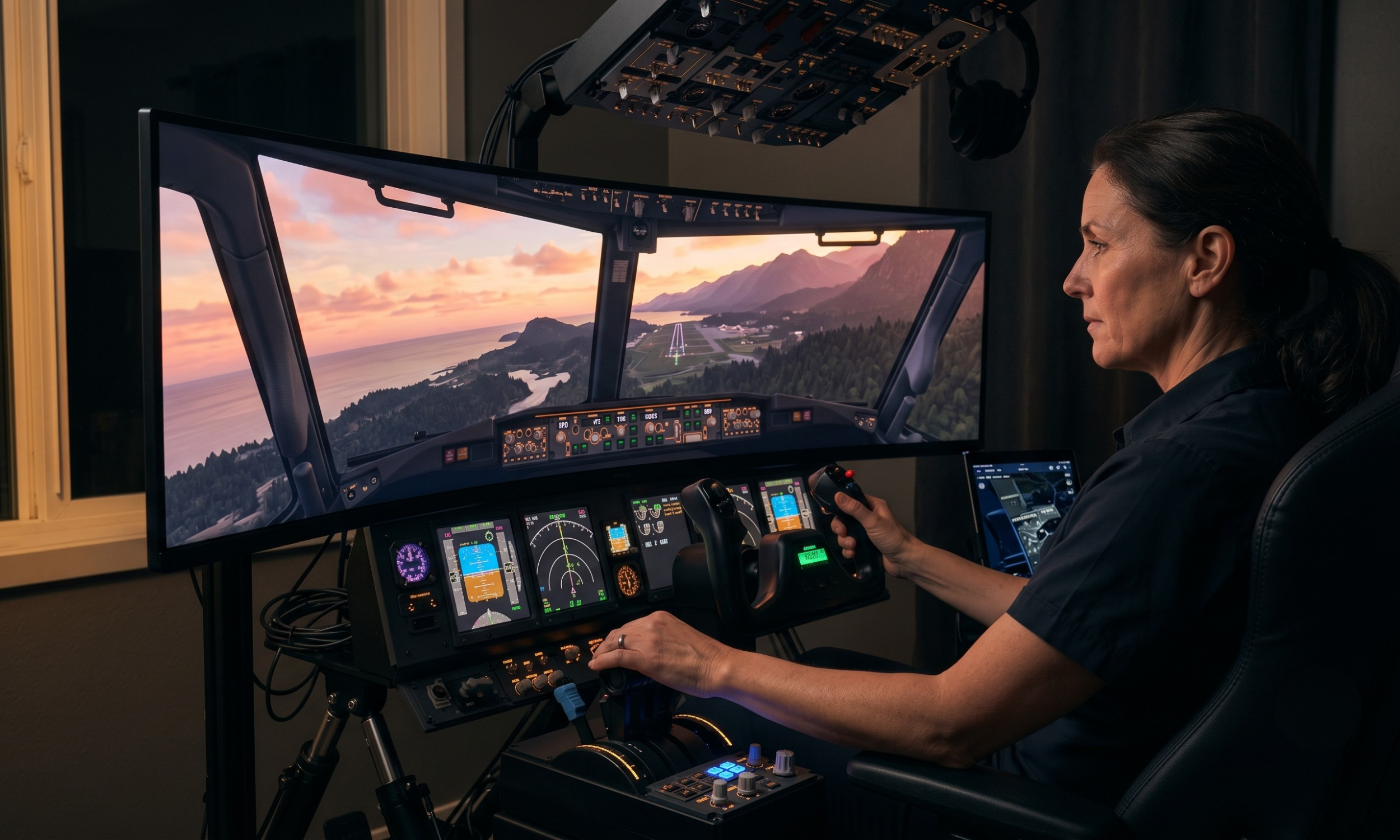
Something has shifted in the flight sim community in 2026. Motion platforms, once a niche within a niche, are showing up in home cockpits at a rate that would have seemed unlikely even two years ago. The hardware has matured, the prices have come down to the point where a capable flight motion setup costs less than a high-end yoke and throttle quadrant, and MSFS 2024 has made the visual fidelity good enough that the missing piece is no longer what you see but what you feel.
Here is what is driving the shift, what motion actually adds to flight simulation, and why the conversation is different to sim racing.
The problem motion solves in flight sim
Flight simulation in 2026 is visually stunning. MSFS renders photogrammetry cities, volumetric weather, and dynamic lighting that would have been unthinkable a decade ago. X-Plane 12 models aerodynamics with serious fidelity. DCS replicates military systems down to individual switch functions.
But your body feels none of it.
You watch the aircraft bank into a turn, and your inner ear registers nothing. You fly through turbulence that shakes the visual frame, and your seat stays perfectly still. You flare for landing and the nose pitches up on screen while your body remains flat and motionless.
This disconnect is not just an immersion problem. It is a physiological one. Your vestibular system, the part of your inner ear that senses motion and balance, disagrees with what your eyes are showing you. That disagreement is the root cause of VR sickness in flight sim, and it is also why even on a flat screen a long flight session can leave you feeling slightly detached and fatigued.
A motion platform puts your body back in the conversation. The aircraft banks, and your body banks. The turbulence shakes the cockpit, and you feel the turbulence. The approach gets bumpy, and your stomach registers the altitude changes. The disconnect shrinks, and flight starts to feel like flight.
Why flight motion is different to racing motion
If you have read anything about motion platforms, you have probably read it through a sim racing lens. Most of the content out there is written by and for sim racers, and the advice does not always translate to flight.
Racing motion is sharp, frequent and aggressive. Quick weight transfer, hard braking, fast direction changes. The platform spends most of its time making rapid, punchy movements.
Flight motion is the opposite. A banking turn in a Cessna 172 takes seconds, not milliseconds. A climb is gradual and sustained. The descent into an ILS approach is a gentle, continuous pitch adjustment. These are slow, smooth, sustained movements, and they expose weaknesses in motion hardware that racing never reveals.
A platform with slightly notchy motors or imprecise gearing feels fine during a quick sim racing corner because the movement is over before the roughness registers. In flight, that same roughness plays out over seconds and feels mechanical, steppy and distracting. It breaks the immersion it was supposed to create.
This is why flight specific hardware exists and why it matters. Platforms built or configured for flight use gearbox reducers or higher-resolution actuators that smooth out slow movements at the cost of a little outright speed. The speed is unnecessary in a cockpit. The smoothness is everything.
What pilots actually report after adding motion
The feedback from flight sim pilots who have added motion tends to cluster around three things.
Landings change completely. The flare, the float, the moment the main gear touches, these become physical events rather than visual ones. You feel the descent rate in your stomach. You feel the crosswind correction through your body. You feel the gear kiss the runway. Multiple pilots have described this as the single most transformative change in their flight sim experience.
VR becomes sustainable. Many serious flight sim pilots have tried VR and abandoned it because of nausea. Adding motion does not guarantee a cure, but the reduction in sensory conflict makes VR viable for a significant number of pilots who could not previously tolerate it. The physical motion cues align with the visual rotation, and the brain stops fighting itself.
Turbulence and weather have texture. Flying through weather stops being a visual effect and starts being an experience. Light chop feels like light chop. Moderate turbulence makes you grip the yoke. A strong crosswind on short final makes you work for the runway. These are the moments where immersion crosses from entertainment into something that genuinely teaches your hands and body how an aircraft behaves.
The hardware that works for flight in 2026
The motion platform market has responded to flight sim demand with hardware that is actually designed for the job rather than adapted from racing.
Geared flight variants from manufacturers like DOF Reality offer the same frame and actuator count as their racing platforms but with reducer gearboxes fitted to each motor. The result is a platform that handles slow sustained flight cues without the jerkiness that standard motors can produce at low speeds.
UK-built platforms with true heave (the up-and-down axis) add the stomach-drop sensation that matters enormously in flight but is absent from many racing-focused platforms that prioritise roll and yaw instead.
Premium linear actuator platforms from manufacturers like Qubic System deliver the fastest and most precise motion available for home use, with industrial-grade hardware that handles both the slow cues of GA flying and the aggressive manoeuvring of military jets in DCS.
The key takeaway is that flight sim buyers should look specifically for hardware rated and reviewed for flight, not assume that the most popular racing platform is also the best flight platform. The requirements are genuinely different.
The honest caveats
Motion is not magic. A few things worth being straight about.
Setup and tuning matter. A motion platform out of the box with default settings will not feel right for flight. The motion profile needs tuning to match the type of flying you do. An airliner profile should be subtle and smooth. A DCS fighter profile should be aggressive and responsive. Most middleware (SimRacing Studio, SimHub, FlyPT Mover) allows per-aircraft profiles, which is essential for flight sim pilots who fly multiple types.
Space is a real consideration. A full motion platform takes up more room than a static desk cockpit. Measure your space honestly before committing.
Cost is not trivial. A capable flight motion setup starts at around £1,800 to £2,500 for a 2DOF or 3DOF geared platform. That is significant money, and worth comparing against other upgrades (better rudder pedals, a yoke upgrade, a VR headset) to decide where it fits in your priority list.
Not everyone needs it. If you fly casually with a joystick and a single monitor and you are happy with the experience, motion is not going to solve a problem you do not have. It serves pilots who have already invested in good controls and a serious cockpit and are looking for the next level of physical realism.
Why 2026 is the tipping point
The convergence is real. MSFS 2024 has raised the visual bar to the point where physical sensation is the obvious missing piece. VR headsets have reached the resolution and comfort level where wearing one for a full flight is viable. Motion hardware has matured and dropped in price. Flight-specific variants exist. The middleware supports per-aircraft profiles. The flight sim community has moved from "that is a novelty" to "that is the next upgrade."
Motion in flight sim is following the same trajectory that direct-drive wheels followed in sim racing five years ago. It starts as an enthusiast luxury, becomes an informed recommendation, and eventually becomes the expected standard for a serious setup. In 2026, we are in the middle of that curve.
FullMotionSim is an independent publication. We are not paid by manufacturers to write about their products.
